Why It Happens Here
Most of the garage doors we're replacing panels on in Georgetown went up between 1956 and 1979, when steel sectional doors became the standard install on new construction
That's a wide band of housing - median build year lands around 1973 - and it means a lot of original steel still hanging on torsion hardware that's past its working life. Thin-gauge steel from that era dents easier than what's made now, and it rusts from the inside out once the paint seal breaks down.
Georgetown sits in a cold-climate band with real winter severity
And that matters for panels specifically. Repeated freeze-thaw cycles work moisture into seams and bottom-panel joints, and road salt spray off driveways and the street accelerates rust at the bottom one to two feet of the door - the section that takes the most abuse anyway from mowers, bikes, and backing out too fast. A panel that looks fine in August can be flaking rust through by February.
This isn't a one-neighborhood problem
Across the service area the housing stock from that same 1960s-70s window shows up block after block, which is why panel replacement calls don't cluster in one part of town - they follow the age of the door, not the zip code.
Doing It Yourself
If you're set on doing this yourself, start by pulling the model and panel section number off the label on the inside of the door before you order anything. On a door that old, that label may be gone or unreadable, and that's the real obstacle - manufacturers have discontinued a lot of the panel profiles used on doors from the 1956-1979 building wave. You can match screw patterns and panel height reasonably well on paper and still end up with a seam that doesn't sit flush because the ribbing profile changed sometime in the 90s.
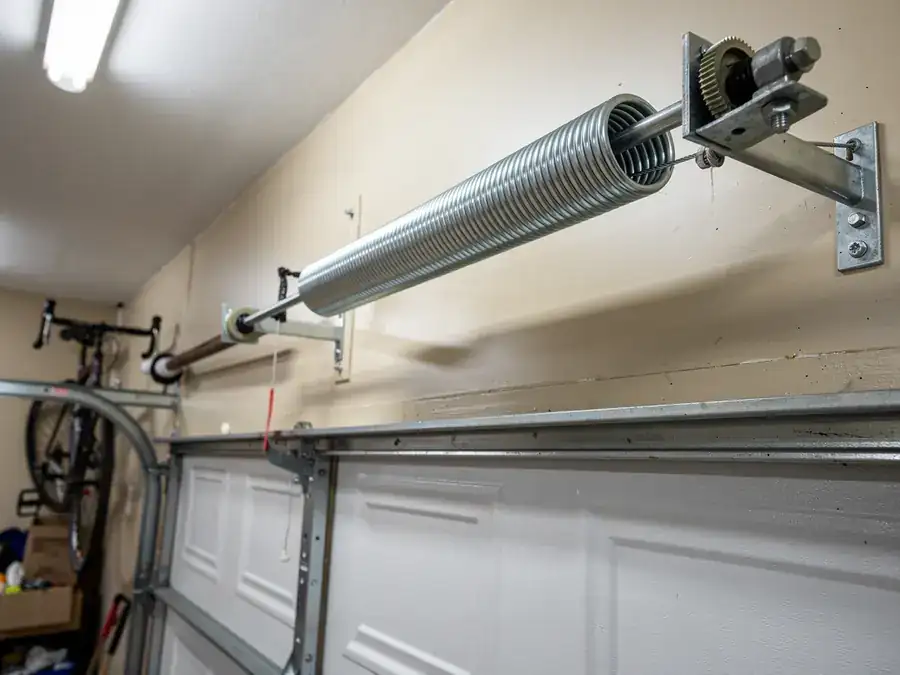
If you do get a matching panel, the job itself is straightforward: disconnect the opener, support the door in the closed position, pull the end hinges and roller brackets off the damaged section, swap it, and re-hang. The part that trips people up is spring tension - don't touch the torsion spring itself unless you know exactly what you're doing, because that's where people get hurt.
Honestly, if you can't find a matching panel, we'll tell you straight that full door replacement is usually the more sensible move at that point rather than chasing a mismatched section that'll stand out and still won't seal right against our winters.
Booking a Visit
We cover Georgetown and work out from there - Stamping Ground is about 8 miles out, Midway 11 16 to the west-southwest, and Paris, Cynthiana, Versailles, and Frankfort all sit in the 15 to 18 mile range. If you're calling from one of those towns, we've got a page specific to your area with the local detail that doesn't belong here.
When you call, have the door's approximate age and which panel is damaged - top, bottom, or one in the middle - ready to go. That tells us whether we're looking at a simple swap or something that needs a look before we quote it. With roughly 8,359 owner-occupied houses across a service area of about 24,518 households, we see enough of these original 60s and 70s doors that most jobs are a known quantity before the truck even rolls.
See our home page for the rest of what we do.
How It Shows Up
The most common call starts with a dent at eye level
A car bumper or a basketball - that's cracked the paint and let rust start underneath. On the older steel stock common in Georgetown, that rust spreads faster than owners expect because the gauge is thinner than anything sold today.
Second most common
A bottom panel that's gone soft and bowed, usually from years of freeze-thaw cycling pushing moisture into the bottom seal channel. You'll see it as a wave along the bottom edge, sometimes with flaking rust along the inside lip where road salt has splashed up over winters.
Less common but real
A full section cracked or buckled from wind load on an older door that was never upgraded with reinforcing struts - something builders in the 1960s and 70s didn't typically spec. If your door's whole middle section is bowing in or out rather than just dented, that's usually this, and it's worth a look before a spring or cable takes the extra strain and fails too. Given the median household income here runs around $56,636, we try to be upfront early on about whether a panel swap makes sense or whether the door's age means that money's better spent on a full replacement.