
Serving Georgetown, KY & nearby
(502) 218-5705
Georgetown, KY

When an Old Georgetown Garage Door Still Has Life Left

Georgetown's housing stock mostly dates to 1956-1979. Here's how that age, plus a cold climate, shapes what a repair actually costs you and when replacement wins.

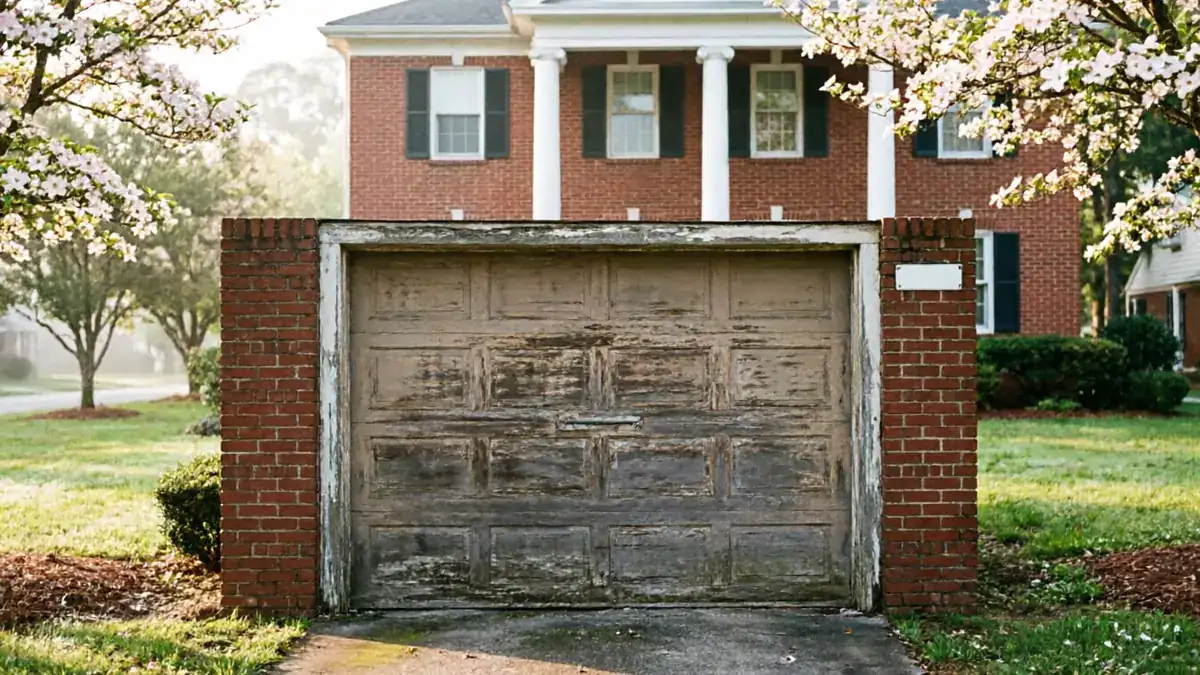
The old wooden garage door has peeling paint and is set in a brick frame.

What You Pay

We're not going to quote you a number here, because what you pay depends on what's actually wrong and what's behind your wall, and we haven't seen your door. What we can tell you is what drives the cost in a town like this one. Most houses in Georgetown's service area went up between 1956 and 1979, with a lot of that stock concentrated in the 1960s and 70s across the six main residential areas we work in. That means a lot of original torsion springs, steel tracks, and panel sections that haven't been touched since the house was built. Parts for doors that age aren't always sitting on a shelf - some hardware from that era has been phased out by manufacturers, and a replacement spring or roller assembly might need to be sourced rather than grabbed off the truck. That adds a day, sometimes more, to a repair that would otherwise be same-visit. If your door is from that original run and the track or jamb has shifted with the house over fifty-plus years, a repair quote has to account for fitting modern parts to an older frame. That's labor, not just parts, and it's the honest reason two houses on the same street can get different numbers for what sounds like the same job.

The Problem

A door built when Nixon was in office wasn't engineered for the duty cycle a household puts on it now, and it wasn't built with the spring life or rust protection you'd get today. Torsion springs on doors from that 1956-1979 window are rated for a fixed number of cycles, and most of them are well past that number by now even if they look fine sitting still. The failure mode is usually sudden: a spring snaps on an ordinary Tuesday, not during a storm. Separate from the springs, steel panels and tracks on houses from that era see real wear from a cold climate - see below - and once rust starts at a hinge or roller bracket, it doesn't reverse itself. The honest problem isn't always the door itself. Sometimes the opener was added later, decades after the door, and it's fighting hardware it was never matched to. That mismatch shows up as grinding, slow travel, or a door that reverses for no clear reason. None of this means the whole unit needs to come out. It means the actual point of failure has to be identified before anyone decides what the fix costs.

How Local Conditions Play In

Georgetown sits in a climate band rated cold and severe, which matters more for garage doors than people expect. Steel contracts in hard cold, and on an older door that's already a little out of square from fifty-plus years of settling, that contraction is what turns a minor gap into a stuck roller or a track that binds on the first freeze of the season. Weatherstripping on doors from the 1960s and 70s era wasn't designed for the kind of temperature swings this climate band sees, and once it's cracked or compressed flat, cold air gets behind the panel and the whole assembly works harder than it should, including the opener motor. None of this is about one bad winter. It's cumulative - a door built in 1973 has been through roughly fifty cold seasons by now, and the hardware shows it in ways a newer installation in a different climate simply wouldn't. If you're hearing a new groan or a hitch in the cycle that only shows up when it's cold, that's not a coincidence tied to the weather - it's the age of the hardware meeting the climate it was never spec'd for.


Doing Nothing For Now

Not every noise needs a truck. If your door still opens and closes on a predictable cycle, closes flush, and the opener isn't straining audibly, you can reasonably wait and keep an eye on it - that's the honest limitation here, we're not going to tell you every older door needs service tomorrow. What changes that calculus is a door that's visibly off-track, a spring with a visible gap in the coil, or an opener that's started reversing mid-cycle. Those are the signs that waiting turns a controlled repair into an emergency call, usually on the coldest morning of the year when steel is least forgiving. Given that a large share of homes in this area share the same 1956-1979 build window, if your neighbor's original door needed a spring last winter, yours is on a similar clock even if it hasn't failed yet. That's not a reason to panic. It's a reason to get it looked at on your schedule instead of on the door's.

How it works

From “it’s stuck” to “it’s fixed”

A man stands in a driveway looking at a gray garage door.

Tell us what’s wrong

Describe the symptom - won’t open, loud bang, opener runs but the door won’t move.

A technician shines a light on a garage door torsion spring.

On-site diagnosis

A technician tests the door under power and by hand and finds what actually failed.

A technician talks to a woman in front of a house with a garage door.

Clear, up-front plan

You get the fix that’s needed and what drives the cost - before any work starts.

A technician presses a button on the wall next to an open garage door.

Repaired & tested

The repair is done, the door is set true and tested, and the work area left clean.

Not sure which repair your door needs in Georgetown, KY? Describe what it’s doing - every job starts with a diagnosis.

How we work

What to expect

Diagnosis first

Every visit starts by finding what actually failed - not a pre-written parts list.

The right part for the door

Springs and openers matched to the door’s weight and age, so the fix holds up.

Straight answers

When a repair makes more sense than a replacement - or the reverse - you hear it plainly.

Clean, careful work

Tension released safely, hardware set true, the door tested under power before we leave.

What we do

Garage Door Services

Repair and installation work for Georgetown homes and businesses.

Questions

Frequently asked

Straight answers about garage door repair in Georgetown. Still unsure? Ask us directly.

Is it worth fixing a garage door from the 1960s or 70s, or should I just replace it?

It depends on what's failing. A spring, roller, or cable replacement on an otherwise solid original door is usually worth doing - the door itself, if the panels aren't rusted through, can outlast several openers. If the track is bent from age or the panels have real rust damage, that's when replacement starts making more sense than chasing repairs on old hardware.

Why does my garage door act up more in winter?

Georgetown's climate band is rated cold and severe, and steel hardware contracts in hard cold. On an older door that's already slightly out of square from decades of settling, that contraction is often what turns a minor issue into a stuck roller or binding track right when the temperature drops.

Can you still get parts for a door from the 1960s or 70s?

Sometimes, sometimes not off the shelf. A lot of Georgetown's housing dates to that 1956-1979 window, and some original hardware from that era has been discontinued by manufacturers. We can usually source a compatible replacement, but it may take longer than a same-visit repair.

Ready to get your garage door sorted?

Request a QuoteCall









