Why It Happens Here
Most of the houses we work on in this service area went up between 1956 and 1979
With the typical build year sitting around 1973. That generation of garage doors came with lighter-gauge lift cables than what gets installed today, and a lot of those original cables are still on the drum decades later. Cable doesn't fail because it's old on its own - it fails because of what cold does to it.
This area sits in a severe cold climate band
Which means repeated freeze-thaw cycles every winter. Moisture gets into the strands, the galvanized coating pits, and the cable loses tensile strength from the inside out before you ever see visible fraying on the surface. Add in decades of grit and dried-out lubricant working into the drum groove, and you get uneven wear on one cable while the other side looks fine - which is exactly the setup for a sudden snap instead of a slow give.
Across the six named areas we cover, the pattern repeats
1960s and 1970s builds, original or first-generation replacement hardware, and cable that was never sized for 50 years of Kentucky winters. That's the job we see on repeat calls - not a design flaw, just old steel cable doing what cold steel does.
- 50 years
Doing It Yourself
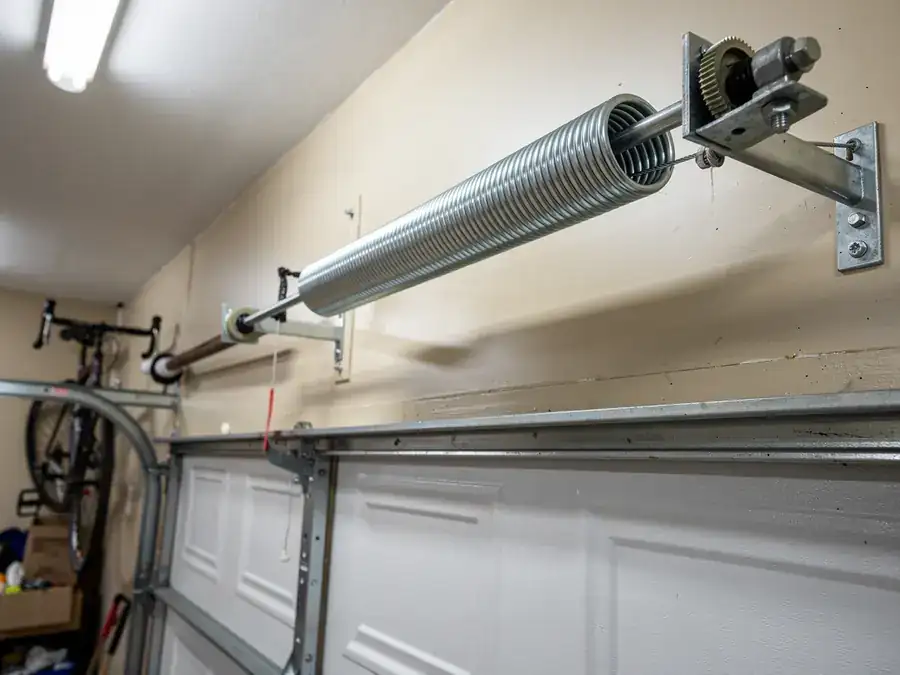
We'll be straight with you: a broken or fraying lift cable is not a safe DIY repair. The cable is under tension from a torsion or extension spring that can store enough force to break fingers or worse if it releases while you're working near it. If one cable has already gone, the other side is carrying the full weight of the door off-balance, and that's an unstable load even for someone who's done the job before.
What you can safely do yourself is spot the problem early. Look at the cable where it wraps the bottom bracket and where it tracks over the drum - fraying usually shows up there first as small broken strands sticking out, sometimes called a "bird cage." If you see that, stop using the door. Don't try to lubricate it back into shape and don't try to re-seat it on the drum.
Our honest limitation here: if the drum, spring, or track has also been damaged by a snapped cable thrashing around, that's a bigger job than a cable swap, and we'll tell you that on-site rather than quote a cable-only price and surprise you later. Sometimes a cable failure is a ten-minute fix. Sometimes it's taken the bottom bracket and part of the track with it.
Booking a Visit
We run cable repair calls across the whole service area - roughly 24,500 households, with about 8,360 of those being owner-occupied houses, the kind of housing stock where original 1960s and 70s hardware is still common. If you're near Georgetown proper or out toward Stamping Ground, Midway, Paris, Cynthiana, Versailles, Frankfort, we cover that range.
Median household income in this area runs around $56,636, and we price cable repair as a standalone job rather than bundling it into a full door replacement unless the inspection actually calls for that. A cable job is usually quick to schedule since it doesn't require ordering a full door or opener - most of what we carry on the truck handles standard residential cable sizes.
When you call, tell us if the door is stuck open, stuck shut, or hanging crooked. That tells us what to bring and whether it's safe for anyone in the house to go near the door before we get there.
How It Shows Up
The most common sign is a door that suddenly hangs crooked
One corner drops lower than the other, or the whole panel tilts on its track. That's usually one cable gone while the other is still holding. You might hear a loud bang or snap right before it happens, especially on a cold morning when the steel is stiffest and least forgiving.
Sometimes it's slower
The door starts binding or jerking partway through its travel, or the opener strains and reverses because the cable is slipping off the drum groove instead of winding evenly. If you look up at the drums near the top corners and see loose, kinked, or unwound cable instead of a tight, even wrap, that's a cable on its way out, not yet fully broken.
Don't force the opener if the door won't move
Running the motor against a failed cable can bend the track or crack a panel, turning a cable repair into a bigger job. Disconnect the opener, leave the door where it is, and call.