Garage Door Service for Georgetown's 1960s and '70s Homes
Service calls for garage doors in Georgetown, KY homes built mostly between 1956 and 1979 - springs, openers, and tracks worn by cold winters and original hardware.
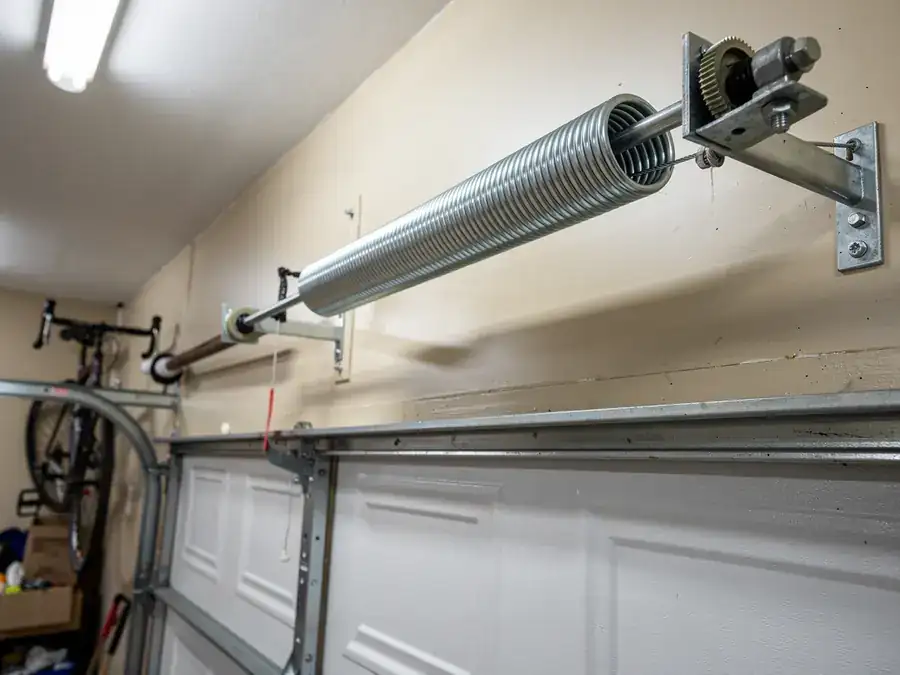
Most houses on this side of Georgetown went up between 1956 and 1979, with the median sitting around 1973, and that matters more than people think when a door starts acting up. A torsion spring wound in the early '70s has been through fifty winters of steel contracting and expanding. Georgetown sits in a severe cold climate band, and cold is what kills springs and hardens lubricant on rollers and hinges faster than anything else. Across the service area's roughly 24,518 households, about 8,359 are owner-occupied houses, and a lot of those garages still carry openers, cables, or tracks that are original to the build. Nobody replaced them because nothing failed - until the metal fatigue finally catches up in a cold snap. We see the same pattern across the six older sections of town built in that same stretch: doors that worked fine for forty years and then quit in the space of one January morning. It isn't bad luck. It's steel and grease doing exactly what steel and grease do after five decades in a cold climate, on hardware nobody has touched since it was installed.
Doing It Yourself
There's real maintenance a homeowner can do without a truck showing up. Wipe down the tracks and check for dirt or old grease buildup - a dry rag does more good than another coat of spray lubricant on top of grime. Pull the emergency release, lift the door by hand to the halfway point, and let go. If it holds, the springs are still carrying their share of the weight. If it drops or shoots up, don't keep opening and closing it - that's the balance test telling you the spring is going, not something to push through. Check the weatherstripping along the bottom panel too; on a lot of the older stock here it's cracked and letting cold air straight into the garage. What you shouldn't do is touch the torsion spring itself. Those are wound under enough tension to break a hand or worse, and we don't recommend any homeowner attempt that adjustment regardless of how simple it looks online. That's the honest limit here - lubricate, inspect, test the balance, and call before you reach for a wrench on the spring itself.
Booking a Visit
We run calls out of Georgetown and the towns around it - Stamping Ground, about 8 miles up the road, Midway at 11 miles, and out to Paris and Cynthiana at 15 miles each. Versailles and Frankfort are both about 18 miles out, 16 miles to the west-southwest, marks roughly the far edge of a same-day run from here. If you're inside that loop, a call in the morning usually gets a truck to you the same day. We ask a few things up front - the age of the door if you know it, whether it's a single or double, and what it's doing (stuck, loud, slow, won't move) - because that tells us what to bring on the truck instead of making a second trip. With a service area this spread out, having that information before we leave the shop saves everyone time.
How It Shows Up
The symptoms track pretty closely with what you'd expect from hardware that age and cold have been working on for years. A door that opens fine in July but groans and hesitates in January is usually a spring that's lost tension and is fighting the opener on every cycle. An opener that strains, reverses on its own, or trips the breaker is often compensating for a spring doing less of the lifting than it used to. Panels on older steel doors - common across the 1960s-70s stock here - can show rust at the bottom seam where water sits, or a slight bow where a cable has stretched unevenly. Rollers that scrape rather than roll usually mean the track has shifted slightly out of plumb, which happens over decades as a house settles. None of these show up overnight. They build for months, sometimes years, and the cold snap just happens to be what finally makes the weak point give out.
How it works
From “it’s stuck” to “it’s fixed”
01
Tell us what’s wrong
Describe the symptom - won’t open, loud bang, opener runs but the door won’t move.
02
On-site diagnosis
A technician tests the door under power and by hand and finds what actually failed.
03
Clear, up-front plan
You get the fix that’s needed and what drives the cost - before any work starts.
04
Repaired & tested
The repair is done, the door is set true and tested, and the work area left clean.
Not sure which repair your door needs in Georgetown, KY? Describe what it’s doing - every job starts with a diagnosis.
Why does my garage door only act up in cold weather?
Steel springs lose a measurable amount of lifting force as temperature drops, and lubricant on rollers and hinges thickens in the cold. In a severe cold climate like Georgetown's, a spring that's already near the end of its life often fails on the first hard freeze rather than gradually. It was weakening all along - cold just finished the job.
My house was built in the 1970s - is the opener original?
It's possible, especially if no one's mentioned replacing it. A lot of Georgetown's housing stock dates to that 1956-1979 window, and original openers from that era weren't built with the safety reversal sensors required today. If yours has never been swapped, it's worth having it looked at regardless of whether it's currently working.
Do you come out to Stamping Ground or Midway?
Yes - Stamping Ground is about 8 miles from Georgetown and Midway is about 11, both well within our regular run. Paris, Cynthiana, Versailles, and Frankfort are all within 15 to 18 miles as well. Call in the morning and we can usually get a truck out the same day.
How do I know if it's the spring or the opener?
Disconnect the opener using the emergency release and lift the door by hand. If it's heavy, hard to lift past halfway, or drops on its own, the spring is losing tension - that's not an opener problem. If the door moves fine by hand but the opener struggles, strains, or won't engage, the issue is in the motor unit or its gearing.