Why It Happens Here
Most of the housing stock in Georgetown went up between 1956 and 1979
With the median build year sitting at 1973. That matters for installation because doors and openers from that era were built to specs nobody uses anymore - narrower track widths, lighter-gauge panels, hardware sized for springs that are hard to match today. When one of those original doors finally gives out, a straight swap rarely works; the opening, the headroom, and the mounting points often need adjusting to take a modern door.
The climate side matters just as much
Georgetown sits in a cold-climate band with severe winter exposure, which means insulation value and bottom-seal performance aren't cosmetic choices - they're what keeps a garage from acting like an open shed for four months a year. A door picked on looks alone, without matching it to that exposure, tends to show gaps and warping faster than people expect.
Put those two things together
A housing stock clustered in a 23-year build window and a climate that punishes a mismatched door - and you get a town where installation jobs skew toward full replacement rather than panel swaps. We size the new door to the opening that's actually there, not the opening the manufacturer assumes.
Doing It Yourself
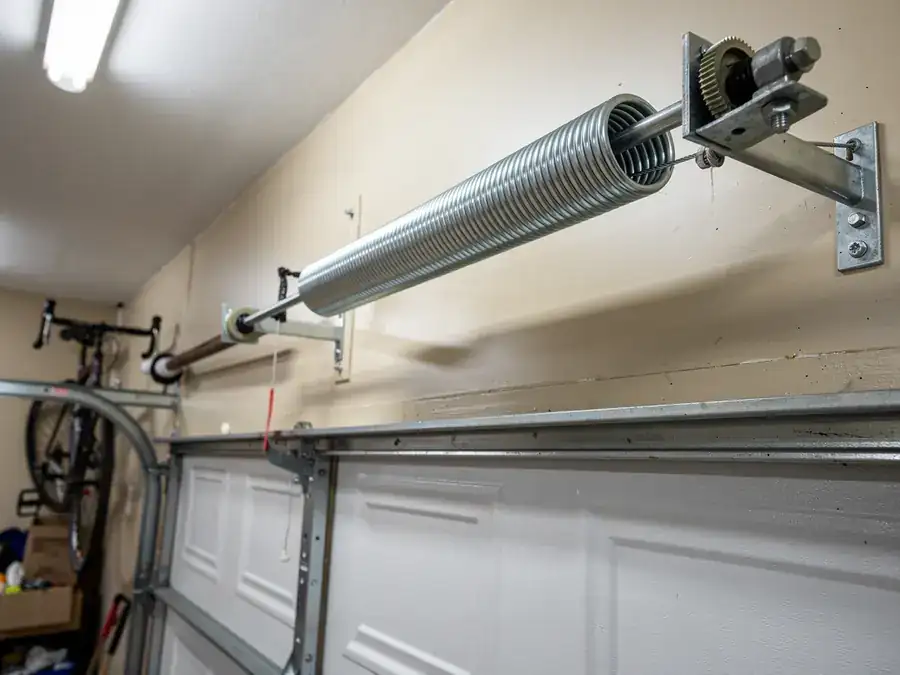
There's real DIY territory in garage doors - weatherstripping, lubricating rollers, tightening loose hardware. Installation isn't in that territory, and we'll say so plainly. A new door means setting tracks plumb, balancing spring tension against the door's actual weight, and getting the opener's force and travel limits dialed in so the safety reverse works. Get any one of those wrong and you've got a door that drops, a cable under the wrong tension, or a sensor that doesn't catch a kid's bike in time.
The other piece people underestimate is matching the door to the opening correctly on a house from the 1956-1979 window. Framing settles, headroom shrinks, and what looks like a standard opening sometimes isn't. We've had to walk away from quoting a job sight-unseen more than once because the only honest answer was "come measure it first."
If you want to do something yourself before calling anyone, measure your opening width, height, and headroom, and note whether your current door is steel, wood, or insulated. That saves time on the visit and lets us bring the right hardware the first time instead of a second trip.
Booking a Visit
We cover Georgetown and work out to the towns around it - Stamping Ground eight miles off, Midway at eleven sixteen miles to the west-southwest, and Paris, Cynthiana, Versailles, and Frankfort each around fifteen to eighteen miles out. None of those are treated as a special trip; they're part of the regular route.
Across that service area there are 24,518 households and 8,359 owner-occupied houses, and median household income runs $56,636. That's useful context for us on the install side - it's why we carry a range of door tiers rather than pushing one price point, since what makes sense for a 1973-built ranch isn't always what makes sense for a newer build nearby.
To book, use the contact link below. Tell us the age of your house if you know it, roughly when the current door went in, and whether you're dealing with a dead opener, a damaged panel, or just a door that's reached the end of its run. That's enough for us to show up with the right gear instead of guessing.
How It Shows Up
On a house from the 1956-1979 stretch, the first sign is usually the door sticking partway up or down
Original track hardware working loose after decades, or a spring that's lost tension and never had it restored. The second sign is cold air you can feel standing in the garage, which in a severe-cold-exposure area like this points straight at seal and insulation failure rather than anything wrong with the opener.
A third pattern: panels that look fine from the driveway but have soft spots or rust at the bottom edge, from years of snow melt sitting against a bottom seal that was never rated for the exposure here
None of these are emergencies in the sense of needing same-day attention, but they're all signs that patching won't buy much more time.
If your door is original to a house built in that window and you're seeing two or more of these, installation is usually the more honest answer than another repair
We'll tell you straight if a repair still has life in it - we don't sell a new door to someone who doesn't need one yet.