Why It Happens Here
Most of the housing around Georgetown went up between 1956 and 1979
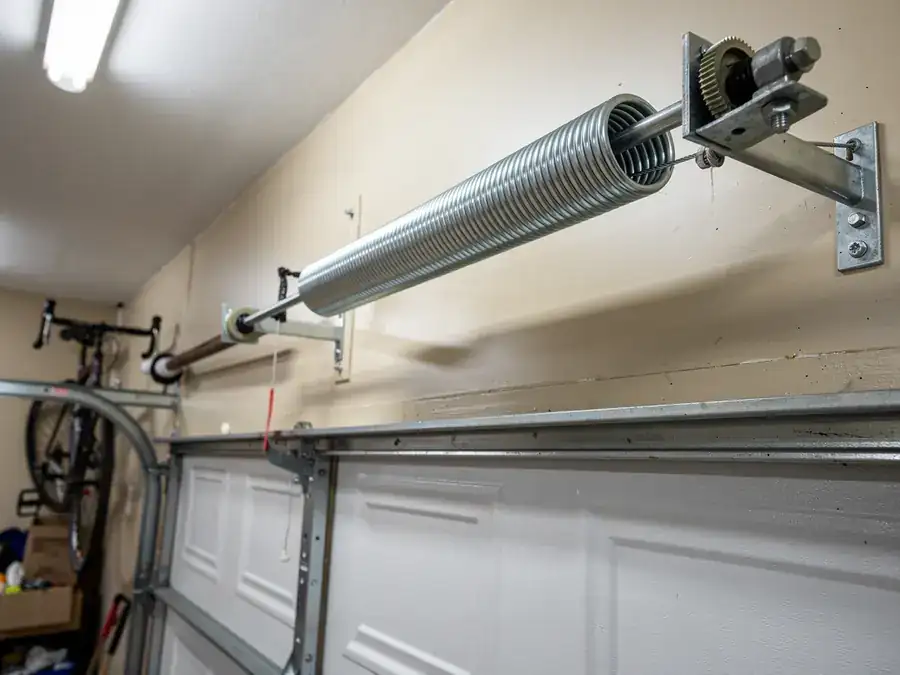
With a median build year of 1973, and that matters more than people think when a door stops working. Doors and openers installed or replaced during that stretch, or matched to the original rough openings from that era, run on torsion spring setups and track widths that weren't built with today's heavier insulated panels in mind. When a homeowner swaps in a modern door but keeps the original jamb and header from a 1960s build, the spring sizing is often off from day one, and the door either slams down fast or won't budge.
The cold is the other half of it
Georgetown sits in a severe cold climate band, and steel springs lose tension and snap more often in a hard freeze than in mild weather - the metal contracts, grease stiffens, and a spring that's been near the end of its cycle count for a year finally lets go on the coldest morning of the week. That combination - older framing geometry plus real winter cold - is why torsion spring failure and opener strain are the calls we see most across the six older sections that make up most of the local stock, not some generic wear-and-tear story.
Doing It Yourself
A torsion spring is not a DIY repair, full stop - it's wound under enough tension to break a wrist or worse, and we don't recommend a homeowner touch it even with the right winding bars. Where you can help yourself: check the track for ice buildup before you call anyone, since a frozen track on an older door will look exactly like a broken spring (door won't lift) but costs nothing to fix once it thaws. Listen for the sound too. A loud bang followed by the door refusing to move is almost always a snapped spring. A slow, grinding struggle that gets worse over a few weeks is usually the opener motor or a worn cable, not the spring.
You can also tighten the mounting bolts on the opener rail and check that the photo-eye sensors near the floor aren't knocked out of alignment - both are five-minute checks that save a truck roll if that's all it is. What you shouldn't do on a house from this era is force the door by hand when it's stuck halfway. The spring tension on these older setups is uneven enough that forcing it can snap a cable or drop the door on something. If it won't move smoothly both ways, stop and call.
Booking a Visit
When you call, tell us the age of the house if you know it and whether the door is original to the build or was replaced at some point - that one detail narrows down what hardware we're likely dealing with before the truck even leaves. Georgetown's median household income sits at $56,636, and across the roughly 8,359 owner-occupied houses in the service area, we see a wide range of what people want to spend: some want the cheapest fix that gets the door moving again, some want it done once and done right with upgraded hardware. We'll give you both options on site rather than assume.
We also cover the towns nearby - Stamping Ground, Midway, Paris, Cynthiana, Versailles, Frankfort - so if you're calling from one of those, say so up front; it doesn't change the diagnosis but it helps us route the day. One honest limit: if a part needs to be special-ordered for an older or oversized door, that's not a same-day fix no matter how bad the weather is. We'll tell you that on the phone, not after we've already driven out.
How It Shows Up
On a house built in the 1960s or '70s stretch that makes up most of Georgetown's stock, the failure pattern tends to look the same: a bang from the garage, then the door either won't lift at all or lifts a few inches and stops
That's a torsion spring giving out under tension that's been building for years, and cold mornings are when it finally happens. You might also notice the opener straining - motor humming, door barely creeping up - which on an older door usually means the spring is already half-gone and the opener is doing a job it was never built to do alone.
A second pattern shows up as a cable fraying near the drum
Which on these older track widths tends to happen unevenly on one side before the other, so the door tilts as it opens. If you see that lean, stop running the door. Across the roughly 24,518 households we serve, these two failures - spring and cable - account for most of the emergency calls we get in the coldest months, and both trace straight back to hardware that's been doing its job since before most of today's owners bought the house.
- 24,518 households